
Okay, she's got her own blog, and this is not going to turn into the Sabrina show here. But I just wanted to link you to this article on the United Hollywood website.
And by the way, Sabrina has now raised $1242. (Where she got this entrepreneurial thing, I have no idea. But I wish I could inherit me some of it!)
Wednesday, January 30, 2008
Tuesday, January 29, 2008
SHE DID IT!
Sabrina set herself three random goals a few weeks ago: (1) To raise $1000 for the Writers Guild Foundation Industry Support Fund through her Readathon; (2) to sell 400 boxes of Girl Scout cookies; and (3) to teach herself French.
Nothing like a little ambition.
The cookie thing isn't going to happen. None of us leaders have the energy to rally the troops to sell-sell-sell, and the strike has made things tough, too. (For instance, one girl typically sells about 400 boxes in a day on the set of her dad's TV show -- a show that's been dark for months now.) I've been telling Sabrina she should set her goal at 100 boxes for weeks. (She's at 160-something -- if she gets to 190 she gets a cute prize. Maybe we'll go for that.)
As for learning French, well, in a year and a half that'll take care of itself when she gets to junior high with its mandatory language class. In the meantime, she's walking around with Cory's French-English dictionary looking things up, insists on calling doughnuts "beignets," and can sing the French song on Guitar Hero III with a creditable accent. Works for me.
Which takes us to goal number 1: To raise $1000 for the Industry Support Fund.
And she did it! As of yesterday, with 950 pages under belt at almost $1 a page, and with a handful of other people making flat monthly donations, she is up to $1056!
I guess I shouldn't say I'm surprised. I am, just a little. But mostly I'm proud.
And somehow I think that goal number is about to be raised...
Nothing like a little ambition.
The cookie thing isn't going to happen. None of us leaders have the energy to rally the troops to sell-sell-sell, and the strike has made things tough, too. (For instance, one girl typically sells about 400 boxes in a day on the set of her dad's TV show -- a show that's been dark for months now.) I've been telling Sabrina she should set her goal at 100 boxes for weeks. (She's at 160-something -- if she gets to 190 she gets a cute prize. Maybe we'll go for that.)
As for learning French, well, in a year and a half that'll take care of itself when she gets to junior high with its mandatory language class. In the meantime, she's walking around with Cory's French-English dictionary looking things up, insists on calling doughnuts "beignets," and can sing the French song on Guitar Hero III with a creditable accent. Works for me.
Which takes us to goal number 1: To raise $1000 for the Industry Support Fund.
And she did it! As of yesterday, with 950 pages under belt at almost $1 a page, and with a handful of other people making flat monthly donations, she is up to $1056!
I guess I shouldn't say I'm surprised. I am, just a little. But mostly I'm proud.
And somehow I think that goal number is about to be raised...
Monday, January 28, 2008
PICKETING WITH ACTORS
Today was a massive "Unity" picket at Fox with members of the Screen Actors Guild. Some 1300 or so folks showed up. 
I hear about 400 of those were actors, but I'm thinking a lot of actors didn't sign in (and get counted officially), because it sure felt like a higher actor:writer ratio than that.
Some thoughts on picketing with actors:
--When you eavesdrop on picketing actors, you hear words you don't hear on a writers' picket line. Words like "commercial" and "audition." And less swearing.
--It is very, very easy to tell actors from writers on the picket line. (Very easy.)
Writers wear tennies. Actors wear boots. Really nice boots.
Writers wear chapstick. Actors wear lip gloss.
Writers wear jeans (that probably don't fit that well). Actors wear skin-tight jeans. Other skin-tight pants are also acceptable.
Writers accessorize with iPods and cellphones. Actors accessorize with scarves, earrings, fabulous hats, belts, cute little jackets, bracelets, collars turned just so, and oh yeah, boots.
It was like walking a runway instead of a picket line. I kept hitting people with my picket sign, I was so busy checking out the cute outfits and wishing I could wear them!

--I hear Callista Flockhart was on the picket line today. I didn't see her. But it didn't matter, because they were all that skinny.
--Actors stand and chat as much as they walk. Writers keep walking. We know it's the last real exercise we'll get till the next strike.
--When it's just writers on the picket line, there's no press. When actors are there, dozens of cameras automatically show up. (No wonder they all dressed so well!)
--The stars who all turned out the first week or so of the strike just weren't there today. Even though the event was planned for the day after the SAG Awards, when a lot of them would be in town. Tina Fey was there. I didn't see her, either. And someone kept insisting they'd seen Hilary Swank, but I think they were mesmerized by the swarm of skinny girls who are not normally on the picket line.
--Picketing in high winds is really not fun. The wind grabs your picket sign and tries to blow you against a fence. (This has nothing to do with actors. But it was windy. Also muddy after the rains -- and there were so many people we spilled off the sidewalks into the mud. Maybe it's okay if you're wearing boots.)
--But the real bottom line on picketing with actors: SAG has been awesome. Truly awesome. They have had our back all the way, especially in honoring our picket line at the Golden Globes and saying they'd do the same for the Oscars. We are truly grateful.
And next time SAG is on strike (like, say, the commercial strike of a few years ago), I will be there. Wearing the cool "WGA-SAG Unity" t-shirt I snagged today).
And maybe a pair of boots.
I hear about 400 of those were actors, but I'm thinking a lot of actors didn't sign in (and get counted officially), because it sure felt like a higher actor:writer ratio than that.
Some thoughts on picketing with actors:
--When you eavesdrop on picketing actors, you hear words you don't hear on a writers' picket line. Words like "commercial" and "audition." And less swearing.
--It is very, very easy to tell actors from writers on the picket line. (Very easy.)
Writers wear tennies. Actors wear boots. Really nice boots.
Writers wear chapstick. Actors wear lip gloss.
Writers wear jeans (that probably don't fit that well). Actors wear skin-tight jeans. Other skin-tight pants are also acceptable.
Writers accessorize with iPods and cellphones. Actors accessorize with scarves, earrings, fabulous hats, belts, cute little jackets, bracelets, collars turned just so, and oh yeah, boots.
It was like walking a runway instead of a picket line. I kept hitting people with my picket sign, I was so busy checking out the cute outfits and wishing I could wear them!
--I hear Callista Flockhart was on the picket line today. I didn't see her. But it didn't matter, because they were all that skinny.
--Actors stand and chat as much as they walk. Writers keep walking. We know it's the last real exercise we'll get till the next strike.
--When it's just writers on the picket line, there's no press. When actors are there, dozens of cameras automatically show up. (No wonder they all dressed so well!)
--The stars who all turned out the first week or so of the strike just weren't there today. Even though the event was planned for the day after the SAG Awards, when a lot of them would be in town. Tina Fey was there. I didn't see her, either. And someone kept insisting they'd seen Hilary Swank, but I think they were mesmerized by the swarm of skinny girls who are not normally on the picket line.
--Picketing in high winds is really not fun. The wind grabs your picket sign and tries to blow you against a fence. (This has nothing to do with actors. But it was windy. Also muddy after the rains -- and there were so many people we spilled off the sidewalks into the mud. Maybe it's okay if you're wearing boots.)
--But the real bottom line on picketing with actors: SAG has been awesome. Truly awesome. They have had our back all the way, especially in honoring our picket line at the Golden Globes and saying they'd do the same for the Oscars. We are truly grateful.
And next time SAG is on strike (like, say, the commercial strike of a few years ago), I will be there. Wearing the cool "WGA-SAG Unity" t-shirt I snagged today).
And maybe a pair of boots.
Saturday, January 26, 2008
THINGS I LIKE ABOUT BEING ON STRIKE
There is a wave of cautious optimism creeping around town. The heads of the WGA negotiating committee have been in "informal talks" all week with a couple of actual CEOs (who never sat down with us before or during the strike previously). Those talks haven't fallen apart. Rumors are slipping out that those talks have, in fact, been productive. And the sheer pressure to settle this before the Oscars, to not lose the hundreds of millions of dollars it would mean for the strike to decimate the Oscars, grows every day.
And yesterday I found myself feeling almost regretful (almost) that the strike will probably end soon.
Well, that's insane, isn't it?
Not necessarily. Here are some things I like being on strike.
1) No pressure. You know how a muscle can hurt hurt hurt and you get so used to it you don't even realize it till it stops? That's what day-to-day life in the industry is like when you're trying to get your next gig. Lots of pain. Every day waiting to hear what this week's random executive or producer thinks of you, every day wiggling to position yourself as the perfect answer to their dilemma, every day working your brains out and draining your imagination dryfor free to solve someone else's problem, every day waiting for the phone to ring with good news even as you know that when it rings it will (statistically) be bad news.
All that's gone. Yeah, the phone doesn't ring much, but hey, if it's gonna be bad news anyway, then who misses it? We're not allowed to meet with those folks, not allowed to step onto a studio lot, so there's no pressure to do it right. Woo-hoo!
2) Writers are equal. Early in the strike, people were still in the mode where your credits determine your value. There were writers choosing where to picket based on who they might meet and network with. It feels as if this has diminished (of course, I'm not a TV writer, and that's where the action was, so maybe I'm just missing it).
And online I've also noticed less of the self-positioning. I hear a lot of people voicing respect for genres that are typically often pooh-poohed (Soap operas. Game shows.). I see people boasting about their bad credits. I see people being open and honest about how long they've been out of work at a time (I'll see your 9 months and raise you 2 years!). I see an acknowledgement that the best writers are not necessarily the ones working the most, and that things can turn around (for better or for worse) in a day. There's a relaxation about these truths that are normally not spoken.
3) Being outside. My life is spent in front of screens. Usually this one, my computer screen. But TV and movie screens as well. Oh, and my cell phone screen. The slugline of my life is definitely INT., not EXT.
But now, for hours (almost) every day, I get outside. No, it's not a power walk, we're not burning massive calories here. It's more of an amble than a stride. But I shuffle around in the outdoors, usually in the sunshine. It's different. And I have interesting conversations with people who are always smart and witty (If you have to go on strike, writers are definitely the group to strike with).
Not a bad thing.
4) A different agenda. My life is mostly wrapped up around myself, around my to-do list. I check things off my list, my personal agenda for each day, and I can see what I've accomplished for the day.
But when you're picketing, you can't check anything off your list. Not even phone calls, I've learned, because no Bluetooth can stand up to the sheer noise of hundreds of cars driving by and honking. No, all you can do is walk and chat.
That means, for me at least, that I am spending chunks of 3 hours or so where what I want, what I need, what I have to do, is completely set aside. I can't "get things done." All I can do is trust that what I am doing is significant, that it is okay to be part of a large crowd. An extra in someone else's movie, as it were, rather than the star of my own. "Trust and obey."
For someone as list-driven as me, this is pretty major. And I think it's good for me. Your mileage, of course, may vary.
There are many things, of course, that I don't like about being on strike. Lack of income. Lack of the possibility of income. Saying "no" to my kids every day. The weird psychological effect it has on trying to write. Not being able to plan. Many, many things.
But (surprise, surprise), it ain't all bad.
And yesterday I found myself feeling almost regretful (almost) that the strike will probably end soon.
Well, that's insane, isn't it?
Not necessarily. Here are some things I like being on strike.
1) No pressure. You know how a muscle can hurt hurt hurt and you get so used to it you don't even realize it till it stops? That's what day-to-day life in the industry is like when you're trying to get your next gig. Lots of pain. Every day waiting to hear what this week's random executive or producer thinks of you, every day wiggling to position yourself as the perfect answer to their dilemma, every day working your brains out and draining your imagination dryfor free to solve someone else's problem, every day waiting for the phone to ring with good news even as you know that when it rings it will (statistically) be bad news.
All that's gone. Yeah, the phone doesn't ring much, but hey, if it's gonna be bad news anyway, then who misses it? We're not allowed to meet with those folks, not allowed to step onto a studio lot, so there's no pressure to do it right. Woo-hoo!
2) Writers are equal. Early in the strike, people were still in the mode where your credits determine your value. There were writers choosing where to picket based on who they might meet and network with. It feels as if this has diminished (of course, I'm not a TV writer, and that's where the action was, so maybe I'm just missing it).
And online I've also noticed less of the self-positioning. I hear a lot of people voicing respect for genres that are typically often pooh-poohed (Soap operas. Game shows.). I see people boasting about their bad credits. I see people being open and honest about how long they've been out of work at a time (I'll see your 9 months and raise you 2 years!). I see an acknowledgement that the best writers are not necessarily the ones working the most, and that things can turn around (for better or for worse) in a day. There's a relaxation about these truths that are normally not spoken.
3) Being outside. My life is spent in front of screens. Usually this one, my computer screen. But TV and movie screens as well. Oh, and my cell phone screen. The slugline of my life is definitely INT., not EXT.
But now, for hours (almost) every day, I get outside. No, it's not a power walk, we're not burning massive calories here. It's more of an amble than a stride. But I shuffle around in the outdoors, usually in the sunshine. It's different. And I have interesting conversations with people who are always smart and witty (If you have to go on strike, writers are definitely the group to strike with).
Not a bad thing.
4) A different agenda. My life is mostly wrapped up around myself, around my to-do list. I check things off my list, my personal agenda for each day, and I can see what I've accomplished for the day.
But when you're picketing, you can't check anything off your list. Not even phone calls, I've learned, because no Bluetooth can stand up to the sheer noise of hundreds of cars driving by and honking. No, all you can do is walk and chat.
That means, for me at least, that I am spending chunks of 3 hours or so where what I want, what I need, what I have to do, is completely set aside. I can't "get things done." All I can do is trust that what I am doing is significant, that it is okay to be part of a large crowd. An extra in someone else's movie, as it were, rather than the star of my own. "Trust and obey."
For someone as list-driven as me, this is pretty major. And I think it's good for me. Your mileage, of course, may vary.
There are many things, of course, that I don't like about being on strike. Lack of income. Lack of the possibility of income. Saying "no" to my kids every day. The weird psychological effect it has on trying to write. Not being able to plan. Many, many things.
But (surprise, surprise), it ain't all bad.
Thursday, January 24, 2008
NEWS FROM THE READATHON
Not much news from the picket line this week. "Informal talks" have started (this time with some of the actual CEOs of the studios/networks rather than with their trained poodle, Nick Counter). Because of this, there is a total news blackout. This is all good.
But plenty of news from Sabrina's Readathon in support of people who are out of work due to the writers' strike.
Sabrina has raised $724 so far, and is hoping to hit $1000. I think she'll do it. (Lee said, "Wouldn't it be great if she got to $2000?" "Shh!" I responded, "We don't want the strike to last that long!"
She is being featured in her school's newsletter this week -- hopefully she'll get some more subscribers there, and even better, some other kids who want to read for a penny a page as well.
Her readathon is also being touted in some of the promotional e-mails going out for the 168-Hour Film Festival (Not sure who arranged that, but a couple of her supporters are on their board, so I'm guessing that's the link.)
And it looks as if she's being interviewed by a rep from the WGA next week to be featured in the "Writers on the Line" newsletter that's available at every picket line. This follows up on someone at the Guild telling her she was an "honorary member" of the WGA, which just put her over the roof with pride. (She now has a WGA pin on her backpack and WGA strike signs hanging as posters over her bed.)
This is all so great for her, since 2007 was very much about Cory, in lots of different ways. Now she gets a chance to shine just a little.
Not bad for a little girl who decided to read some books and raise some money.
But plenty of news from Sabrina's Readathon in support of people who are out of work due to the writers' strike.
Sabrina has raised $724 so far, and is hoping to hit $1000. I think she'll do it. (Lee said, "Wouldn't it be great if she got to $2000?" "Shh!" I responded, "We don't want the strike to last that long!"
She is being featured in her school's newsletter this week -- hopefully she'll get some more subscribers there, and even better, some other kids who want to read for a penny a page as well.
Her readathon is also being touted in some of the promotional e-mails going out for the 168-Hour Film Festival (Not sure who arranged that, but a couple of her supporters are on their board, so I'm guessing that's the link.)
And it looks as if she's being interviewed by a rep from the WGA next week to be featured in the "Writers on the Line" newsletter that's available at every picket line. This follows up on someone at the Guild telling her she was an "honorary member" of the WGA, which just put her over the roof with pride. (She now has a WGA pin on her backpack and WGA strike signs hanging as posters over her bed.)
This is all so great for her, since 2007 was very much about Cory, in lots of different ways. Now she gets a chance to shine just a little.
Not bad for a little girl who decided to read some books and raise some money.
Monday, January 21, 2008
TV THOUGHTS: TERMINATOR: THE SARAH CONNOR CHRONICLES
Maybe my reaction is colored by the fact that it's been literally weeks since I've seen any new scripted episodes on TV, and I was just hungry to see a story rather than a competition... but I liked Sarah Connor Chronicles. Wasn't over the moon crazy about it, but I liked it.
The two-part pilot covered the major plot element that needed to be dealt with: Why is there danger of Skynet reforming after Arnold melted himself at the end of T2? It picked up from (more or less) the end of T2 cleanly, and captured a good sense of the emotion of the first two movies.
Casting is not as great as the movie casting (but would one expect it to be)? Lena Headey, playing Sarah Connor, isn't as commanding as Linda Hamilton, and doesn't have her voice, which makes the voiceovers somewhat less compelling and raw as in the movies. She feels more like the post-Terminator 1 Sarah, not the kick-ass wild woman of T2.
My suspicion is that stories and emphasis will shift more to Thomas Dekker, playing the young John Connor. He's the one they're really trying to kill, after all, and the new "good Terminator" has been sent to protect him, not Sarah. Also, as my daughter pointed out, Dekker looks an awfully lot like Zac Efron, so I have to think his fan club will grow pretty fast.
As for that "new Terminator" -- Cameron (named, of course for Jim Cameron), played by Summer Glau -- I think she's a terrific addition story-wise. They played the reveal of this pretty teenage girl Terminator very well, and her sometimes odd understanding of humans plays more interestingly out of the mouth of a girl.
The real question facing the series is where it goes from here. It's already turning into The Fugitive. John Connor runs for his life, an array of bad-ass Terminators chase him and try to kill him, he runs again... Lots of tightly-shot fight scenes, judicious use of effects, some explosions. Fine for two hours, given that they had to get the Miles Dyson storyline started and lay in the backstory. But will that be enough to keep it going for 100 episodes? Do they have some future plot twists in mind to keep us interested?
For right now, those questions may not matter. Because no matter what, SCC is way more worth our Monday nights than Dance Wars. And for right now, that's enough.
The two-part pilot covered the major plot element that needed to be dealt with: Why is there danger of Skynet reforming after Arnold melted himself at the end of T2? It picked up from (more or less) the end of T2 cleanly, and captured a good sense of the emotion of the first two movies.
Casting is not as great as the movie casting (but would one expect it to be)? Lena Headey, playing Sarah Connor, isn't as commanding as Linda Hamilton, and doesn't have her voice, which makes the voiceovers somewhat less compelling and raw as in the movies. She feels more like the post-Terminator 1 Sarah, not the kick-ass wild woman of T2.
My suspicion is that stories and emphasis will shift more to Thomas Dekker, playing the young John Connor. He's the one they're really trying to kill, after all, and the new "good Terminator" has been sent to protect him, not Sarah. Also, as my daughter pointed out, Dekker looks an awfully lot like Zac Efron, so I have to think his fan club will grow pretty fast.
As for that "new Terminator" -- Cameron (named, of course for Jim Cameron), played by Summer Glau -- I think she's a terrific addition story-wise. They played the reveal of this pretty teenage girl Terminator very well, and her sometimes odd understanding of humans plays more interestingly out of the mouth of a girl.
The real question facing the series is where it goes from here. It's already turning into The Fugitive. John Connor runs for his life, an array of bad-ass Terminators chase him and try to kill him, he runs again... Lots of tightly-shot fight scenes, judicious use of effects, some explosions. Fine for two hours, given that they had to get the Miles Dyson storyline started and lay in the backstory. But will that be enough to keep it going for 100 episodes? Do they have some future plot twists in mind to keep us interested?
For right now, those questions may not matter. Because no matter what, SCC is way more worth our Monday nights than Dance Wars. And for right now, that's enough.
Saturday, January 19, 2008
MOVIE THOUGHTS: THE DIVING BELL AND THE BUTTERFLY
Oh, I am so behind on movie posts. It all comes from spending hours a week walking in a small circle with a sign in one's hand, I suspect. (Or maybe it's because I'm also tending to and monitoring Sabrina's blog.)
Anyway...
The Diving Bell and the Butterfly has started to stack up some critics' awards, and of course there's the two Golden Globes it won for best foreign language film and best director (What?! You didn't know it won 2 Golden Globes? Gee, it's almost like there wasn't a ceremon-- oh, yeah.)
But I digress.
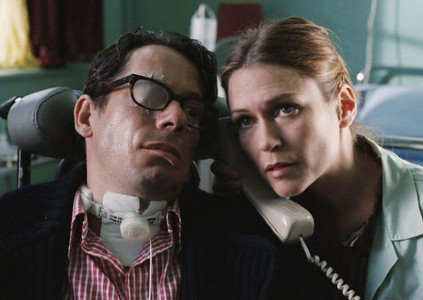
The movie is based on the true story of the editor of French Elle magazine, who had a massive stroke that left him utterly incapcitated except for his brain and one eye. He manages to communicate by the blinking of that eye, and tells the story of what it's like to be trapped inside your body.
The first 20 minutes or so of the movie are absolutely fascinating, as they are almost completely told from the editor's POV. Quite a tour de force to hold this extremely limited POV for so long. It's almost a shock, in fact, when we reverse the angle and actually see the poor guy.
After that... well, it's interesting to watch him try to communicate. And all nicely done, well acted, strong camera work, etc.
But I sort of think I'd rather have seen the documentary version of the story. Because after the first half hour or so, not much happens, we don't learn much. It's just more of the same until he finishes his book and dies. Oh, there are incidents -- the arrival of his mistress, he's taken to the beach -- but nothing changes. And without change, can you say you have drama?
Again, it's all very well done, and manages to hold our attention -- quite a feat, actually, given how little there is to work with. I found myself very impressed with some of the filmmaking techniques.
But I walked away from the movie unmoved. I should have stepped out of the theatre profoundly saddened, maybe profoundly grateful. I should have found myself meditating on something along the lines of John Donne's "No Man is an Island." I didn't though. I was intellectually interested, but nothing more.
And therefore I can only recommend it to people already interested, or who want to see how the filmmaking challenges were handled. It would be a great disappointment if this movie, well-intentioned and executed as it is, were to garner a lot of attention at Oscar time because, ultimately, while well-done, it's just not what it might have been.
Anyway...
The Diving Bell and the Butterfly has started to stack up some critics' awards, and of course there's the two Golden Globes it won for best foreign language film and best director (What?! You didn't know it won 2 Golden Globes? Gee, it's almost like there wasn't a ceremon-- oh, yeah.)
But I digress.
The movie is based on the true story of the editor of French Elle magazine, who had a massive stroke that left him utterly incapcitated except for his brain and one eye. He manages to communicate by the blinking of that eye, and tells the story of what it's like to be trapped inside your body.
The first 20 minutes or so of the movie are absolutely fascinating, as they are almost completely told from the editor's POV. Quite a tour de force to hold this extremely limited POV for so long. It's almost a shock, in fact, when we reverse the angle and actually see the poor guy.
After that... well, it's interesting to watch him try to communicate. And all nicely done, well acted, strong camera work, etc.
But I sort of think I'd rather have seen the documentary version of the story. Because after the first half hour or so, not much happens, we don't learn much. It's just more of the same until he finishes his book and dies. Oh, there are incidents -- the arrival of his mistress, he's taken to the beach -- but nothing changes. And without change, can you say you have drama?
Again, it's all very well done, and manages to hold our attention -- quite a feat, actually, given how little there is to work with. I found myself very impressed with some of the filmmaking techniques.
But I walked away from the movie unmoved. I should have stepped out of the theatre profoundly saddened, maybe profoundly grateful. I should have found myself meditating on something along the lines of John Donne's "No Man is an Island." I didn't though. I was intellectually interested, but nothing more.
And therefore I can only recommend it to people already interested, or who want to see how the filmmaking challenges were handled. It would be a great disappointment if this movie, well-intentioned and executed as it is, were to garner a lot of attention at Oscar time because, ultimately, while well-done, it's just not what it might have been.
Friday, January 18, 2008
THE DGA SETTLES... NOW WHAT?
Well, the big, much-awaited news came yesterday. The DGA settled their negotiations with the AMPTP and have a "tentative agreement."
We don't have the real numbers yet, just the synopsis issued in the press release. And we don't have the definitions (e.g., when they say "Internet," what do they mean?)
But parts of it look pretty good. (Other parts, not so much, at least not if you transferred it as is to the writers.)
Key elements that look good: The AMPTP has acknowledged that the Directors Guild should have jurisdiction over productions made for the internet. I'm concerned about what seem like exceedingly high budget minimums for those productions, which could conceivably make this provision largely moot. But the very idea of jurisdiction is part of what we've been striking for.
The other biggie: Distributor's gross.
Here's what the AMPTP said on December 7 when they walked away from the negotiating table. They laid down six ultimata, saying they would not return to the table until we removed all these demands, including:
But they just made a deal with the DGA in which payments for internet material are based on "distributor's gross" (i.e., the actual licensing fee paid, rather than the tiny portion of that fee which ends up in the pocket of the producer of the material).
Now, again, we haven't seen the actual language. Maybe the AMPTP managed to redefine "distributor's gross" so that it means "Not distributor's gross." Nothing would surprise me, given their history of deception. But this does sound promising.
Other areas, not so promising, particularly, it would seem, for TV episodic writers. But I'm waiting to see the number crunching explanation before I fully decide.
Now why, you ask, should the DGA deal matter to the writers? Good question.
It matters because of the history of pattern bargaining in the entertainment industry. What we get, and what SAG gets, will largely be patterned on what the DGA gets. (This is why the AMPTP stalled on our negotiations, choosing to negotiate instead with the union that was not on strike -- they thought they could get a better deal with the DGA, then use that as a pattern to make the WGA and SAG fall in line.)
Traditionally the DGA rolls over and makes a weak deal. But this time it's been a bit different. They've made a much stronger deal than anyone anywhere ever expected them to make. Why?
Because of our strike. Because they realized that if they made too weak a deal, the strike wouldn't end, and SAG would join us on strike in July, and no one would go back to work. Our strike allowed the DGA to play "good cop." It allowed them to play a stronger hand than they ever would have otherwise.
But it's not over. Directors' and writers' needs may overlap, but they are not identical. Parts of the DGA deal could be deceptively disastrous for certain categories of writers. Other issues only apply to writers and have to be dealt with from scratch. Many truly horrible proposals from the AMPTP (for instance, they want to remove the writer's name from all advertising -- huh? Why? To save the millions of dollars all that ink would cost? Sorry, but that's just bullying.)
So the strike continues. Yes, "informal talks" (as opposed to formal negotiations) will begin between the WGA and the AMPTP soon. But it's not over. The 2007-2008 TV season is fairly decimated, the 2008 pilot season hangs in the balance, 2009's movies aren't getting shot because the strike kept scripts from being finished, and the Oscars are coming (or not).
The DGA deal may be good news. Is it good enough? We don't know yet.
Meanwhile, we walk.
We don't have the real numbers yet, just the synopsis issued in the press release. And we don't have the definitions (e.g., when they say "Internet," what do they mean?)
But parts of it look pretty good. (Other parts, not so much, at least not if you transferred it as is to the writers.)
Key elements that look good: The AMPTP has acknowledged that the Directors Guild should have jurisdiction over productions made for the internet. I'm concerned about what seem like exceedingly high budget minimums for those productions, which could conceivably make this provision largely moot. But the very idea of jurisdiction is part of what we've been striking for.
The other biggie: Distributor's gross.
Here's what the AMPTP said on December 7 when they walked away from the negotiating table. They laid down six ultimata, saying they would not return to the table until we removed all these demands, including:
Lastly, we cannot agree to any new residual formula based upon the concept of “Distributor’s Gross.” That is, any residual formula that requires payment to be made based upon the receipts of an entity other than the signatory Company is unacceptable to us. Our agreement to share revenues with you must be limited to those revenues actually received by the signatory Company.
But they just made a deal with the DGA in which payments for internet material are based on "distributor's gross" (i.e., the actual licensing fee paid, rather than the tiny portion of that fee which ends up in the pocket of the producer of the material).
Now, again, we haven't seen the actual language. Maybe the AMPTP managed to redefine "distributor's gross" so that it means "Not distributor's gross." Nothing would surprise me, given their history of deception. But this does sound promising.
Other areas, not so promising, particularly, it would seem, for TV episodic writers. But I'm waiting to see the number crunching explanation before I fully decide.
Now why, you ask, should the DGA deal matter to the writers? Good question.
It matters because of the history of pattern bargaining in the entertainment industry. What we get, and what SAG gets, will largely be patterned on what the DGA gets. (This is why the AMPTP stalled on our negotiations, choosing to negotiate instead with the union that was not on strike -- they thought they could get a better deal with the DGA, then use that as a pattern to make the WGA and SAG fall in line.)
Traditionally the DGA rolls over and makes a weak deal. But this time it's been a bit different. They've made a much stronger deal than anyone anywhere ever expected them to make. Why?
Because of our strike. Because they realized that if they made too weak a deal, the strike wouldn't end, and SAG would join us on strike in July, and no one would go back to work. Our strike allowed the DGA to play "good cop." It allowed them to play a stronger hand than they ever would have otherwise.
But it's not over. Directors' and writers' needs may overlap, but they are not identical. Parts of the DGA deal could be deceptively disastrous for certain categories of writers. Other issues only apply to writers and have to be dealt with from scratch. Many truly horrible proposals from the AMPTP (for instance, they want to remove the writer's name from all advertising -- huh? Why? To save the millions of dollars all that ink would cost? Sorry, but that's just bullying.)
So the strike continues. Yes, "informal talks" (as opposed to formal negotiations) will begin between the WGA and the AMPTP soon. But it's not over. The 2007-2008 TV season is fairly decimated, the 2008 pilot season hangs in the balance, 2009's movies aren't getting shot because the strike kept scripts from being finished, and the Oscars are coming (or not).
The DGA deal may be good news. Is it good enough? We don't know yet.
Meanwhile, we walk.
Wednesday, January 16, 2008
BOOK THOUGHTS: THE NORTH FACE OF GOD
One of the toughest things to face as a Christian is the silence of God. The silence that says (at least implies) that He isn't listening. He isn't there. He doesn't give a rip.
The most comforting and encouraging reading material I've found in the face of such silence is, of course, the Psalms. Their very presence in the Bible lets us know that it's okay to feel abandoned, to cry at night in agony, to be angry at God's absence.
After the Psalms, however, there's really not much out there (that I've found) that speaks to the level of anguish I have sometimes felt. Sure, I read Philip Yancey's Disappointment with God and found it... well... disappointing.
But now I have found a book that speaks at such deep levels, I expect to hand it to many people over the years.
The North Face of God by Ken Gire likens coping with the crushing absence of God to the brutal task of climbing Mt. Everest. He takes us from base camp up the side of the mountain, step by step. Along the way, we visit the issues of our need for a "climbing team," what happens when we face the worst we can face, and who our enemy really is.
I almost don't want to say too much, don't want to start quoting, because the book is so beautifully written, and I want you to walk its path yourself. Suffice it say that the subtitle of the book is Hope for the times when God seems indifferent. The North Face of God does indeed, in my opinion, deliver on this promise.
Having come through an intensely difficult year, I found this the perfect book to start 2008 with. If you have faced, or are facing, anything tough, you will find it gives you hope and courage as well.
The most comforting and encouraging reading material I've found in the face of such silence is, of course, the Psalms. Their very presence in the Bible lets us know that it's okay to feel abandoned, to cry at night in agony, to be angry at God's absence.
After the Psalms, however, there's really not much out there (that I've found) that speaks to the level of anguish I have sometimes felt. Sure, I read Philip Yancey's Disappointment with God and found it... well... disappointing.
But now I have found a book that speaks at such deep levels, I expect to hand it to many people over the years.
The North Face of God by Ken Gire likens coping with the crushing absence of God to the brutal task of climbing Mt. Everest. He takes us from base camp up the side of the mountain, step by step. Along the way, we visit the issues of our need for a "climbing team," what happens when we face the worst we can face, and who our enemy really is.
I almost don't want to say too much, don't want to start quoting, because the book is so beautifully written, and I want you to walk its path yourself. Suffice it say that the subtitle of the book is Hope for the times when God seems indifferent. The North Face of God does indeed, in my opinion, deliver on this promise.
Having come through an intensely difficult year, I found this the perfect book to start 2008 with. If you have faced, or are facing, anything tough, you will find it gives you hope and courage as well.
Tuesday, January 15, 2008
WEEK 11... AND THE STRIKE GOES ON...
A lot has happened on the strike front in the last few days.
1) The forces majeures (I assume that's how it's pluralized?) have started. (You may remember I predicted that there would be no movement until the studios invoked force majeure and started terminating people.) Dozens of writers are having their deals canceled at every network. All at once. As if, perhaps, the networks/studios knew they had little time left to play that particular card.
2) The DGA started formal negotiations on Saturday. They were supposed to start in November... then December... They postponed in large part because of our strike, but informal talks were going on all that time. The DGA has stated that they would not commence formal negotiations until they were "within shouting distance" of a deal. So we are expecting the DGA deal to be announced, really, at any moment.
What does this mean for the WGA? It depends. If the DGA makes a great deal in the area of New Media (i.e., internet residuals), then we will probably invoke the concept of pattern bargaining and let it be know that we'll take a similar deal. The strike will be over in a very few weeks. However, if the DGA "rolls over" and accepts a weak deal (as they have historically done), the WGA will not take it (and neither will SAG). In this event, the strike will go on indefinitely, no one will go back to work, and things will get very nasty.
The whole thing is a high-stakes game of poker, but it's one of those fancy games you played in high school which involve passing cards to the person on your right, that kind of thing. The WGA has passed the DGA a pair of aces. Now we see if the DGA has the guts to play them.
3) The Golden Globes sucked. Why does that matter, you ask (other than revealing the Globes to be the sham they have always been)? Well, the Oscars are coming. And the Oscars do matter. A lot. So far the strike has really affected TV, not features. But if we were to shut down the Oscars, that affects the feature world. Hey, Tom Hanks says so, so it must be true, right?
And it just happens that the producer of this year's Oscars is also the head of the DGA Negotiating Committee. So how will his desire to make a quick and easy DGA deal (hoping to save his show) balance against his realization that he has to make a deal that SAG and the WGA will accept (hoping to save his show)? I guess we'll learn very soon.
...In the meantime, Sabrina's Readathon continues. So far she has raised $367 for cast and crew who are out of work due to the strike. We are proud of her.
And we hope she raises a lot more money... in a very short time frame.
1) The forces majeures (I assume that's how it's pluralized?) have started. (You may remember I predicted that there would be no movement until the studios invoked force majeure and started terminating people.) Dozens of writers are having their deals canceled at every network. All at once. As if, perhaps, the networks/studios knew they had little time left to play that particular card.
2) The DGA started formal negotiations on Saturday. They were supposed to start in November... then December... They postponed in large part because of our strike, but informal talks were going on all that time. The DGA has stated that they would not commence formal negotiations until they were "within shouting distance" of a deal. So we are expecting the DGA deal to be announced, really, at any moment.
What does this mean for the WGA? It depends. If the DGA makes a great deal in the area of New Media (i.e., internet residuals), then we will probably invoke the concept of pattern bargaining and let it be know that we'll take a similar deal. The strike will be over in a very few weeks. However, if the DGA "rolls over" and accepts a weak deal (as they have historically done), the WGA will not take it (and neither will SAG). In this event, the strike will go on indefinitely, no one will go back to work, and things will get very nasty.
The whole thing is a high-stakes game of poker, but it's one of those fancy games you played in high school which involve passing cards to the person on your right, that kind of thing. The WGA has passed the DGA a pair of aces. Now we see if the DGA has the guts to play them.
3) The Golden Globes sucked. Why does that matter, you ask (other than revealing the Globes to be the sham they have always been)? Well, the Oscars are coming. And the Oscars do matter. A lot. So far the strike has really affected TV, not features. But if we were to shut down the Oscars, that affects the feature world. Hey, Tom Hanks says so, so it must be true, right?
And it just happens that the producer of this year's Oscars is also the head of the DGA Negotiating Committee. So how will his desire to make a quick and easy DGA deal (hoping to save his show) balance against his realization that he has to make a deal that SAG and the WGA will accept (hoping to save his show)? I guess we'll learn very soon.
...In the meantime, Sabrina's Readathon continues. So far she has raised $367 for cast and crew who are out of work due to the strike. We are proud of her.
And we hope she raises a lot more money... in a very short time frame.
Friday, January 11, 2008
MOVIE THOUGHTS: ALVIN AND THE CHIPMUNKS
No, I didn't go to Alvin because I was dying to see it. And I didn't go because it was a WGA freebie (it wasn't; gee, I can't imagine why the producers didn't think it was award-worthy!)... I went because Sabrina really reeeaalllly wanted to go. And because she set up a playdate with a friend to go.
And it wasn't nearly as bad as I expected. I've gone to movies that were waaay worse in service of my kids.
They came up with a basic white-bread storyline: "Dave" (remember Dave from the Chipmunks' Christmas song?) is a down-on-his-luck aspiring songwriter who finds himself taking care of three singing chipmunks. The 'Munks are a huge hit, they leave Dave for the lures of fame and fortune, then end up back where they belong.
The Chipmunks themselves are cutely done, though you can tell some corner-cutting took place on the CGI front. In fact, corner-cutting is evident throughout the movie (lots of continuity errors, for instance -- things like addresses changing on the same building across shots -- yes, there are people who notice these things.) Performances are okay (probably as good as the material would allow). Production design, cinematography, etc. all speak to this being done on the cheap.
But there's a sweetness to it that explains why it's been such an unexpectedly huge hit, why it was a must-see for my daughter and her friends. The moment (surprisingly early on in the story) when the Chipmunks sing their Christmas song is actually quite nostalgically emotional, and other such moments pop up here and there throughout the story.
When Lee and I teach about how to choose the story you want to tell, we preach "feeling is first." Write a story with real feeling, a story that engenders real feeling, and the rest should follow. Well, that's more or less what the Chipmunks' creators did here -- whether intentionally or by accident, they found a story that works emotionally, and the cheapness of the actual production turns out not to matter all that much as a consequence.
Not that I'm recommending it. There are better ways to spend your $10. But if you have to go, you probably won't mind it as much as you might expect.
And it wasn't nearly as bad as I expected. I've gone to movies that were waaay worse in service of my kids.
They came up with a basic white-bread storyline: "Dave" (remember Dave from the Chipmunks' Christmas song?) is a down-on-his-luck aspiring songwriter who finds himself taking care of three singing chipmunks. The 'Munks are a huge hit, they leave Dave for the lures of fame and fortune, then end up back where they belong.
The Chipmunks themselves are cutely done, though you can tell some corner-cutting took place on the CGI front. In fact, corner-cutting is evident throughout the movie (lots of continuity errors, for instance -- things like addresses changing on the same building across shots -- yes, there are people who notice these things.) Performances are okay (probably as good as the material would allow). Production design, cinematography, etc. all speak to this being done on the cheap.
But there's a sweetness to it that explains why it's been such an unexpectedly huge hit, why it was a must-see for my daughter and her friends. The moment (surprisingly early on in the story) when the Chipmunks sing their Christmas song is actually quite nostalgically emotional, and other such moments pop up here and there throughout the story.
When Lee and I teach about how to choose the story you want to tell, we preach "feeling is first." Write a story with real feeling, a story that engenders real feeling, and the rest should follow. Well, that's more or less what the Chipmunks' creators did here -- whether intentionally or by accident, they found a story that works emotionally, and the cheapness of the actual production turns out not to matter all that much as a consequence.
Not that I'm recommending it. There are better ways to spend your $10. But if you have to go, you probably won't mind it as much as you might expect.
Thursday, January 10, 2008
SABRINA'S READATHON
Sabrina has wanted to do something to help the Writers' Guild strike for a long time. She wrote the essay I posted here, wanted to make a video... and now she has come up with a cool fundraising idea.
Well, she didn't actually come up with the original idea. (Credit where credit is due, after all.) I mentioned something I'd read on a WGA-affiliated site about someone doing something similar, and she asked if kids could do the same thing. And ran with it from there.

Here's the idea: Sabrina is embarking on a readathon. She will read her little heart out from now to the end of the strike. She is asking supporters to pledge a penny per page that she reads. She'll post or e-mail what books she's read and how many pages, and ask her supporters to send in checks commensurate with their pledges to The Writers Guild Foundation Industry Support Fund or The Actors Fund. The two funds are coordinating relief for non-writers affected by the strike.
Sabrina has set up a blog, Sabrina's Readathon to keep track of her efforts. You can go there and pledge to support her by leaving a comment (with your e-mail please), or you could e-mail me or leave me a comment. Or you can e-mail Sabrina directly at StrikeReadathon@aol.com.
And by the way, you can pledge more than a penny per page if you want. Just wanted to make that clear! (And thanks to those of you who already have! Yes, Vickie, I mean you!)
I'm really proud of her for doing this, and hope she gets enough support for her to feel she's doing something valuable to contribute. Click on over and take a look. Thanks!
Well, she didn't actually come up with the original idea. (Credit where credit is due, after all.) I mentioned something I'd read on a WGA-affiliated site about someone doing something similar, and she asked if kids could do the same thing. And ran with it from there.
Here's the idea: Sabrina is embarking on a readathon. She will read her little heart out from now to the end of the strike. She is asking supporters to pledge a penny per page that she reads. She'll post or e-mail what books she's read and how many pages, and ask her supporters to send in checks commensurate with their pledges to The Writers Guild Foundation Industry Support Fund or The Actors Fund. The two funds are coordinating relief for non-writers affected by the strike.
Sabrina has set up a blog, Sabrina's Readathon to keep track of her efforts. You can go there and pledge to support her by leaving a comment (with your e-mail please), or you could e-mail me or leave me a comment. Or you can e-mail Sabrina directly at StrikeReadathon@aol.com.
And by the way, you can pledge more than a penny per page if you want. Just wanted to make that clear! (And thanks to those of you who already have! Yes, Vickie, I mean you!)
I'm really proud of her for doing this, and hope she gets enough support for her to feel she's doing something valuable to contribute. Click on over and take a look. Thanks!
Wednesday, January 09, 2008
NOTES FROM THE LINE, WEEK 10
Well, we're 10 weeks into the Writers Strike, and we're still walking.
(The other night Jon Stewart compared the writers walking in circles to that great early shot in Conan the Barbarian where scrawny Conan walks in circles pushing that mill or whatever it is, and turns into Arnold Schwarzenegger. Ha! I wish.)
We've been transferred from Sony to Fox (Picketing is suspended at Sony, who knows why). Somehow I'm finding Fox not as friendly. Also, we literally march in circles there, rather than crossing the street. I guess I'm old school. I like crossing the street. There's a rhythm to it -- waiting for the walk signal, making sure you push the botton... I'll get used to Fox, I'm sure.
A couple of interesting moves on the lack-of-negotiations front...
As you have probably read, the Golden Globes will not be happening, at least not in their usual booze-soaked-party format. Major props and gratitude to SAG for so wholeheartedly supporting the WGA! To get 70 stars to refuse to cross the picket line was a pretty solid accomplishment.
Now, we all know the Golden Globes don't really "matter" as awards, given as they are by a group of approximately 80 foreign journalists from news organizations no one's ever heard of (the London Times? Le Monde? sorry, not included). So why bother to shut them down?
Because the Oscars are coming. And they matter. Boy, do they matter. (I think back a couple of years to when Crash won Best Picture over the expected Brokeback Mountain, and the producers of Brokeback complained bitterly even though they'd won every other award out there. Why? Because the Oscars are the only ones that matter.)
The WGA may have shut down this year's TV season, but there's really no way we can affect features in a discernible way until at least mid-2009. Except for the Oscars. That's a way to remind people on the feature side of the business that they, too, need to sit down and negotiate a deal.
(Remember, the WGA is still at the table, waiting for the AMPTP to return. The AMPTP has walked out of negotiations twice, and there's really nothing the writers can do to move things forward until the studios/networks agree to sit down and talk again.)
You've probably also seen that the WGA has done interim deals with David Letterman and with Tom Cruise's United Artists. I think these are good ideas. Cracks in the dike, as it were. Signs that we can do a reasonable deal that people are happy to sign on to, on both the feature and TV sides of the equation. Not significant in themselves, but hopefully the beginning of discontented moguls realizing that they too could break away and make a deal on their own.
And in the meantime... we walk. It's cold now (not nearly as cold as for those walking in New York, of course!). It's not exciting anymore. The snacks are lagging seriously. And I'm getting to the point where I see faces and don't know if I know them, or if I've just seen them walking in circles so many times I think I know them.
But walking is the best way to visually drive home the point that we're still here, we're still waiting. And I've managed not to get a single blister yet, so walk I will.
I'm thinking February. Maybe March. Hopefully no longer than that. Maybe I can turn into Conan by then...
(The other night Jon Stewart compared the writers walking in circles to that great early shot in Conan the Barbarian where scrawny Conan walks in circles pushing that mill or whatever it is, and turns into Arnold Schwarzenegger. Ha! I wish.)
We've been transferred from Sony to Fox (Picketing is suspended at Sony, who knows why). Somehow I'm finding Fox not as friendly. Also, we literally march in circles there, rather than crossing the street. I guess I'm old school. I like crossing the street. There's a rhythm to it -- waiting for the walk signal, making sure you push the botton... I'll get used to Fox, I'm sure.
A couple of interesting moves on the lack-of-negotiations front...
As you have probably read, the Golden Globes will not be happening, at least not in their usual booze-soaked-party format. Major props and gratitude to SAG for so wholeheartedly supporting the WGA! To get 70 stars to refuse to cross the picket line was a pretty solid accomplishment.
Now, we all know the Golden Globes don't really "matter" as awards, given as they are by a group of approximately 80 foreign journalists from news organizations no one's ever heard of (the London Times? Le Monde? sorry, not included). So why bother to shut them down?
Because the Oscars are coming. And they matter. Boy, do they matter. (I think back a couple of years to when Crash won Best Picture over the expected Brokeback Mountain, and the producers of Brokeback complained bitterly even though they'd won every other award out there. Why? Because the Oscars are the only ones that matter.)
The WGA may have shut down this year's TV season, but there's really no way we can affect features in a discernible way until at least mid-2009. Except for the Oscars. That's a way to remind people on the feature side of the business that they, too, need to sit down and negotiate a deal.
(Remember, the WGA is still at the table, waiting for the AMPTP to return. The AMPTP has walked out of negotiations twice, and there's really nothing the writers can do to move things forward until the studios/networks agree to sit down and talk again.)
You've probably also seen that the WGA has done interim deals with David Letterman and with Tom Cruise's United Artists. I think these are good ideas. Cracks in the dike, as it were. Signs that we can do a reasonable deal that people are happy to sign on to, on both the feature and TV sides of the equation. Not significant in themselves, but hopefully the beginning of discontented moguls realizing that they too could break away and make a deal on their own.
And in the meantime... we walk. It's cold now (not nearly as cold as for those walking in New York, of course!). It's not exciting anymore. The snacks are lagging seriously. And I'm getting to the point where I see faces and don't know if I know them, or if I've just seen them walking in circles so many times I think I know them.
But walking is the best way to visually drive home the point that we're still here, we're still waiting. And I've managed not to get a single blister yet, so walk I will.
I'm thinking February. Maybe March. Hopefully no longer than that. Maybe I can turn into Conan by then...
Tuesday, January 08, 2008
MOVIE THOUGHTS: NATIONAL TREASURE 2: BOOK OF SECRETS
A man I used to know whose politics were extremely right-wing once expressed to me how frustrating he found the movie The American President. He loved the movie, and he was extremely uncomfortable with the fact that he loved it. The characters in it, he felt, stood for everything he didn't believe in, and he hated the fact that, for the duration of the movie, he believed what they believed, cared about what they cared about.
Of course, this just shows that the movie, as a movie, worked.
I had somewhat the same reaction to National Treasure 2. I really enjoyed it. Quite a bit, especially given that I've never been a Nicolas Cage fan.
Did I believe it? Nope. Not for a minute (at least not for those minutes after the halfway point). But the filmmakers got me to willingly suspend my disbelief. And as a result, I really had fun.
I won't give you the whole plot synopsis (do I ever?) -- the bare bones are that Nic Cage sets out to clear the name of an ancestor wrongly accused of being in league with John Wilkes Booth, and somehow that results in his finding a massive treasure under Mount Rushmore. (Start suspending that disbelief now!)
For me, the key moment came when Cage declares that he needs to kidnap the President of the United States (not a spoiler, as it was in several trailers). This is the point where the movie jumps the shark. And it's the point where the audience has to decide whether to roll its collective eyes or say, "Hey, jumping a shark sounds fun! I can go on that ride!" and just go along with the filmmakers, wherever they zanily decide to take us.
I decided to go on the ride. And I had fun. I can't justify it as great storytelling. I just had fun.
Performances are all good -- Jon Voight, Helen Mirren. Even Cage -- he must have done something right if I still liked him at the end of the movie. Production values are all top rate. Puzzles were decently constructed.
And it's fun.
Of course, this just shows that the movie, as a movie, worked.
I had somewhat the same reaction to National Treasure 2. I really enjoyed it. Quite a bit, especially given that I've never been a Nicolas Cage fan.
Did I believe it? Nope. Not for a minute (at least not for those minutes after the halfway point). But the filmmakers got me to willingly suspend my disbelief. And as a result, I really had fun.
I won't give you the whole plot synopsis (do I ever?) -- the bare bones are that Nic Cage sets out to clear the name of an ancestor wrongly accused of being in league with John Wilkes Booth, and somehow that results in his finding a massive treasure under Mount Rushmore. (Start suspending that disbelief now!)
For me, the key moment came when Cage declares that he needs to kidnap the President of the United States (not a spoiler, as it was in several trailers). This is the point where the movie jumps the shark. And it's the point where the audience has to decide whether to roll its collective eyes or say, "Hey, jumping a shark sounds fun! I can go on that ride!" and just go along with the filmmakers, wherever they zanily decide to take us.
I decided to go on the ride. And I had fun. I can't justify it as great storytelling. I just had fun.
Performances are all good -- Jon Voight, Helen Mirren. Even Cage -- he must have done something right if I still liked him at the end of the movie. Production values are all top rate. Puzzles were decently constructed.
And it's fun.
Monday, January 07, 2008
NEW YEAR'S RESOLUTIONS 2008
As you probably know, this blog started as the result of a New Year's resolution (2004). And if you've read any of my previous annual resolution posts, you know that I take resolutions seriously.
But not the diet/exercise/bad habit kind of resolution. No, instead I try to find resolutions that will make small differences on a larger basis than the daily habit level.
Last year was a truly crappy year for me. Not the kind of year where you really pay attention to your resolutions, because so much garbage is raining down on your head. So I was surprised to look back and see that I actually did really well on one of my resolutions.
I resolved to cook "real food" for my family on a regular basis -- and I did it. In fact, I did it really well. So props to me on that one. (Other resolutions, such as making an effort to spend time with people sort of fizzled by mid-year. Sigh.)
But with a new year, we get to make new resolutions, right? ("How 'bout posting more regularly?" I hear you mutter.)
So here are this year's.
The first one actually was triggered a few months ago, when Madeleine L'Engle died. At that point, I found myself wanting to dig back into her oeuvre, and decided to read my way through her writings during this year.
My second resolution involves a revamping of how I track income and expenditures (I did the same kind of thing with my prayer request lists a few years ago, and I think it worked well) -- sort of a bookkeeping spring cleaning. Like switching over to a new operating system.
And the third resolution is the big one for the year. An ironic one, too, since my original impetus to take New Year's resolutions seriously came from learning to say 'no.'
I learned that lesson very well. Maybe too well. I've come to realize that 'no' has become my default answer. If I'm invited to something, I weigh my response in terms of considering why I should go. But after a year of hearing 'no' all too many times, I think I'm ready for 'yes.'
So this year, I resolve to say 'yes' to things I might have dismissed without thought in the past. That doesn't mean I'll say yes to everything. But if, say, a former student invites me to the screening of his film, I'll look for the reasons why I shouldn't go, rather than starting off assuming I shouldn't go and looking for the reasons why I should.
And I'll keep cooking "real food." And okay, yeah, I'll post here more often, too.
Happy New Year!
But not the diet/exercise/bad habit kind of resolution. No, instead I try to find resolutions that will make small differences on a larger basis than the daily habit level.
Last year was a truly crappy year for me. Not the kind of year where you really pay attention to your resolutions, because so much garbage is raining down on your head. So I was surprised to look back and see that I actually did really well on one of my resolutions.
I resolved to cook "real food" for my family on a regular basis -- and I did it. In fact, I did it really well. So props to me on that one. (Other resolutions, such as making an effort to spend time with people sort of fizzled by mid-year. Sigh.)
But with a new year, we get to make new resolutions, right? ("How 'bout posting more regularly?" I hear you mutter.)
So here are this year's.
The first one actually was triggered a few months ago, when Madeleine L'Engle died. At that point, I found myself wanting to dig back into her oeuvre, and decided to read my way through her writings during this year.
My second resolution involves a revamping of how I track income and expenditures (I did the same kind of thing with my prayer request lists a few years ago, and I think it worked well) -- sort of a bookkeeping spring cleaning. Like switching over to a new operating system.
And the third resolution is the big one for the year. An ironic one, too, since my original impetus to take New Year's resolutions seriously came from learning to say 'no.'
I learned that lesson very well. Maybe too well. I've come to realize that 'no' has become my default answer. If I'm invited to something, I weigh my response in terms of considering why I should go. But after a year of hearing 'no' all too many times, I think I'm ready for 'yes.'
So this year, I resolve to say 'yes' to things I might have dismissed without thought in the past. That doesn't mean I'll say yes to everything. But if, say, a former student invites me to the screening of his film, I'll look for the reasons why I shouldn't go, rather than starting off assuming I shouldn't go and looking for the reasons why I should.
And I'll keep cooking "real food." And okay, yeah, I'll post here more often, too.
Happy New Year!
Subscribe to:
Comments (Atom)


